

Guru Purnima: The Eternal Principle
“…The Guru here is not merely a person, but the principle of direct transmission—be it through form or formlessness. Whether through a human adept, an inner voice that cuts through delusion, or a deep communion with a deity-form, it is this grace that liberates, not the personality of the messenger. But it is equally true that, for this grace to flow, the heart must be open and the vessel strong enough to receive…”
~ Igor Kufayev
Today on this full moon, this auspicious occasion of Guru Purnima we celebrate in devoted adoration, the relationship that encompasses them all.
On the night traditionally set aside across many parts of the world to honour and offer one’s deepest reverence to one’s teachers, we share in its essence and most intimate meaning, in receptivity to the flow of all knowledge.
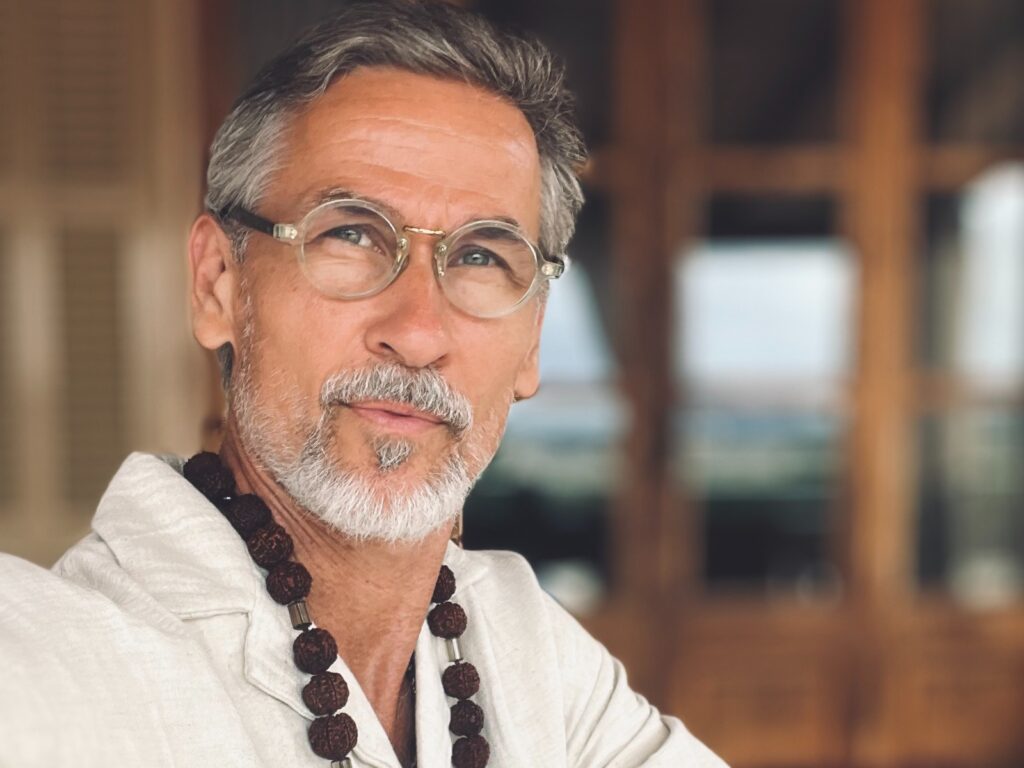
Igor Vamadeva Kufayev often emphasises that ours is the inner path of worship, where ritual turns inward first and the highest offering is made within oneself—the path most suited to the householder, for whom the senses become portals of offering and one’s heart the altar. Such is the tantric way: the sacred unfolds in the innermost chambers of one’s Heart, where the most refined offering can be made, and where the most subtle dimension of existence may be encountered—that which transcends the mind and reveals what human existence is ultimately capable of realising.
In this, the Guru principle, is what holds creation together—the thread that remains in the dim of forgetfulness and the resonance that turns the heart onto itself in recognition. Its own etymology speaks of that which both conceals and reveals—the perpetual movement in which the purpose of existence is continually affirmed through the act of knowing itself and through the unbounded and indiscriminate movement of Grace, forever sustaining creation while disclosing its own essence, both within time and beyond it, whenever the conditions have ripened.
After all, how else could the knowledge of one’s own true Self be revealed and tasted except through relationship? It is this most sacred dynamic that the Guru embodies, and that this day so powerfully celebrates—where the opening is created and steadied for transmission, leaving room only for the infinite, in the gaps between what is spoken and unspoken, from heart to heart.
To those whom we acknowledge as our teachers, we offer this inner tribute. And as we each aspire to embody our own roles with sincerity and fullness, we recognise the one who has assumed the form of teacher—and indeed every teacher before. This day is both the symbol of that mystery and, for those prepared to receive it, its living esoteric transmission.
May we receive this sacred knowledge as pure gnosis, illumined by Śakti, who reveals what could otherwise never be known, and through the Guru, by whose grace alone such recognition is bestowed.
_____
Below, is an extended passage taken from the published KUṆḌALINĪ book, which reflects upon the nature and dynamics of the most misunderstood yet important relationship one will ever have with one’s Self…
The Shared Consensus on Spiritual Authority and Spiritual Maturity
by Igor Kufayev
Inasmuch as we have been mapping out and leaning on the traditional understanding of the process, giving ourselves a solid foundation from which to explore the intricacies of spiritual anatomy, we have scarcely touched upon the question of being worthy of the process itself. And yet, in certain traditions, this very worthiness is seen as a prerequisite, rather than merely a fortunate condition. For many of us today—particularly those not shaped by a cultural milieu where spiritual receptivity is embedded from birth—there can linger, often unconsciously, a subtle sense of entitlement. We are habituated to partake in what is offered, whether intellectual, emotional, psychological or physical, with the same transactional attitude we bring to other exchanges in a consumer society. This is not to provoke shame, nor suggest that such conditioning is anyone’s fault—it is simply the ambient air we breathe. But because we are speaking of matters so subtle, so rarefied, not to speak of the conditions that make these matters communicable in the first place would be an oversight. The attitude with which one approaches this work is itself part of the energetic equation. This is not a mere footnote to the teaching, but something that affects the very receptivity required for the process to unfold. It either contributes to the creation of a healthy, stable container—or becomes, imperceptibly, an obstacle to it.
What is often missing is the acknowledgment of how we come to the work—what internal gesture we make—carries weight. One cannot simply substitute a monetary transaction for the refinement of inner attitude. There must be an inward orientation of reverence, of earnestness and a quality of deep listening. We are not speaking here merely of the guru-disciple relationship as a formalised social contract, though that certainly forms an important part of the traditional model. Rather, we are pointing to something far subtler: the play of Grace, and how that play requires a certain tuning of the heart. That tuning is not gifted arbitrarily—it is forged in the crucible of longing, sincerity and surrender. The Kularṇava Tantra, one of the foundational texts of the Tantric tradition, states:
Without the grace of the Guru, there is no knowledge; without knowledge, there is no liberation. Therefore, the Guru is to be served with devotion, like Śiva Himself. (XIII.123)
This may, to the modern reader, appear as a hierarchical prescription—indeed, many are quick to dismiss such verses as belonging to a bygone paradigm, redolent of feudal obedience or patriarchal control. The very word guru today often evokes unease, if not scorn. In a world shaped by so-called democratic values, personal autonomy and a well-earned skepticism toward institutional power, the idea of spiritual authority is often viewed as inherently suspect, if not dangerous. Add to this the long shadow cast by recent revelations of abuse and manipulation in both Eastern and Western spiritual circles, and it is no wonder that the soil for such a notion has become difficult to till.
And yet, if we are to speak honestly, this cultural allergy does not eradicate the phenomenon it reacts against—it only blinds us to its subtle necessity. The Kularṇava Tantra speaks not of institutional dominance, but of something far more intimate and interior: a transmission of awakened being that cannot be manufactured, only received. The guru, in this view, is not a person in the ordinary sense. It is not even a role. It is a radiant presence, a living current of Grace, that awakens recognition in us—often through a form, but never limited to it. It is Śiva Himself, disguised in the voice that quickens our longing, the gaze that burns through our confusion, the silence that mirrors back our own true face (at least in accord with the living tradition of Tantra).
The question, then, is not whether we should submit to some outer figure. The question is whether we are willing to soften, to open, to recognise when the Self takes the shape of another—not to dominate, but to remind. In this light, spiritual authority is not an imposition, but an invitation. Not a chain of command, but a ripple of transmission across the vast field of being.
Yet this very possibility, that spiritual transmission can occur through the mirror of another, does not negate the critical reevaluation currently unfolding around the figure of the teacher or guide. Quite the contrary. We are living through a time when the forms and functions of spiritual leadership are being scrutinised with unprecedented rigour. No longer is charisma alone enough. No longer does mere lineage guarantee legitimacy. The old archetypes are being stripped of their veneers—not because the sacred is lost, but because we are being asked to see more clearly what it actually is.
In this light, the teacher-student relationship itself is undergoing an alchemical shift. No longer an unquestioned model rooted in hierarchy or cultural inheritance, it is being rediscovered as a dynamic of energetic alignment—something that arises organically when the field is ripe and the inner compass attuned. It is not about blindly following a figure on a throne or pedestal. It is about learning to trust the resonance of truth, the subtle transmission that speaks directly to the core of one’s being. And that recognition is rarely democratic in the ordinary sense of the word—it is deeply intimate, often inexplicable and unmistakable when it occurs.
The danger, however, lies in mistaking discernment for suspicion, or autonomy for avoidance. Many today pride themselves on being self-directed seekers, unbound by traditions or teachers, carving their own way through the spiritual landscape. There is beauty in that—courage, even. But there is also peril. For without the refining mirror of another, the inner process can too easily collapse into self-reinforcing loops. The deeper shadows remain unseen. The subtler knots go untouched. We may call this freedom, but often it is simply a more sophisticated disguise of pseudo autonomy.
This is why, in the Tantric vision, a true teacher is not someone who provides answers, but someone who disrupts our certainties. Not someone who takes power from us, but someone in whose presence the false structures of power within us begin to dissolve. It is not about following a guru. It is about recognising when the guru principle is alive—and being willing, at least in that moment, to bow to what it reveals.
In this spirit, the role of a spiritual guide can no longer be confined to fixed forms. While the classical framework of guru and disciple remains deeply relevant, it must now be understood in more nuanced terms. For some, a living master may indeed appear—a human presence through whom the transmission is unmistakably ignited. But for others, guidance may come through dreams, through chance encounters or through subtle impressions that seem to arise from nowhere and yet carry the unmistakable fragrance of truth. This, too, is a valid form in the absence of a true śaktipāta, provided the vessel is prepared.
One can also enter into active relationship with archetypal forms of wisdom—divine presences who may not appear in flesh, yet who are accessible through refined perception, pure feeling and subtle inner alignment. This is not a matter of imagination or wishful thinking, but of energetic resonance. As the Kularṇava Tantra declares:
By the mere glance of the Guru, one becomes purified. But by the grace of the Guru, one becomes liberated. (XIII.103)
The Guru here is not merely a person, but the principle of direct transmission—be it through form or formlessness. Whether through a human adept, an inner voice that cuts through delusion, or a deep communion with a deity-form, it is this grace that liberates, not the personality of the messenger. But it is equally true that, for this grace to flow, the heart must be open and the vessel strong enough to receive. Paraphrasing what Abhinavagupta states in his Tantrāloka:
Even the descent of śaktipāta, though spontaneous, requires a vessel—refined and prepared—for it to take root. Otherwise, it passes by, like rain on a polished stone (I.262).
Thus, the conversation about teachers and spiritual authority is not about allegiance or dogma, but about receptivity. It is about recognising that awakening is not merely a solitary project, nor is it the passive inheritance of belief. It is a relational fire—a field of co-arising—where the readiness of the seeker meets the living frequency of transmission, in whatever form that takes.
And yet, for all this, let it not be mistaken: the field of transmission is not a privilege granted to a few. It is the natural condition of reality itself—Śakti’s own play of recognition. The real teacher appears when the student is ready not because of some cosmic rule, but because the veil of resistance has thinned. That appearance might take the form of a sage, a line in a sacred text, a flash of intuition while walking alone in the woods or even an unbearable moment of loss that cracks the shell of identity. Wherever it breaks through, the transmission is the same: a silent force that rearranges everything from within.
Still, this force often wears a human face. And that face can become a mirror—sometimes terrible, sometimes tender—through which we glimpse our own uncreated nature. This is why the presence of a realised being, one who has themselves become transparent to the Source, continues to hold its place, however outmoded the language or unpopular the idea may appear to the modern mind. In the words of Lallā of Kashmir, who roamed naked through the valleys with nothing but this fire in her chest:
I found my teacher close beside me
—and when I looked, I was all alone.
To be alone is to have crossed the threshold where distinction collapses. It is not abandonment, but total immersion. The guide who once stood apart has now melted into the marrow of one’s being. What once appeared as another—the one who spoke, who looked, who pointed—has vanished into the mirrorless depth of Self-knowing. This aloneness is not bereft but brimming. It is the solitude of the summit, where nothing remains to lean upon, not even the image of the path. One no longer walks with the teacher—the teacher has become the pulse of one’s own awareness. The outer presence has dissolved into the innermost, becoming indistinguishable from the very breath, the very gaze, the very silence that now speaks.
Let us not trivialise this sacred thread by reducing it to institutional roles or transactional exchange. Nor should we allow our modern aversion to hierarchy to blind us to the exquisite subtlety of real spiritual maturity. The mark of that maturity is not dependence on authority, but a willingness to stand naked in front of Truth—without pretence, without projection, without turning away. And that, perhaps, is the real meaning of the guru principle in Tantra: not a person, but the part of us that is ready to burn.
*
The above is an excerpt from the published work, KUṆḌALINĪ The Goddess as the Power of Self-Recognition in Tantric Śaivism, taken from the chapter named as ‘The Sacrificial Pyre of Re-Animation’. The book is available now to purchase and can be ordered at www.songpublishing.org/kundalini
Photos: Courtesy of Igor Kufayev
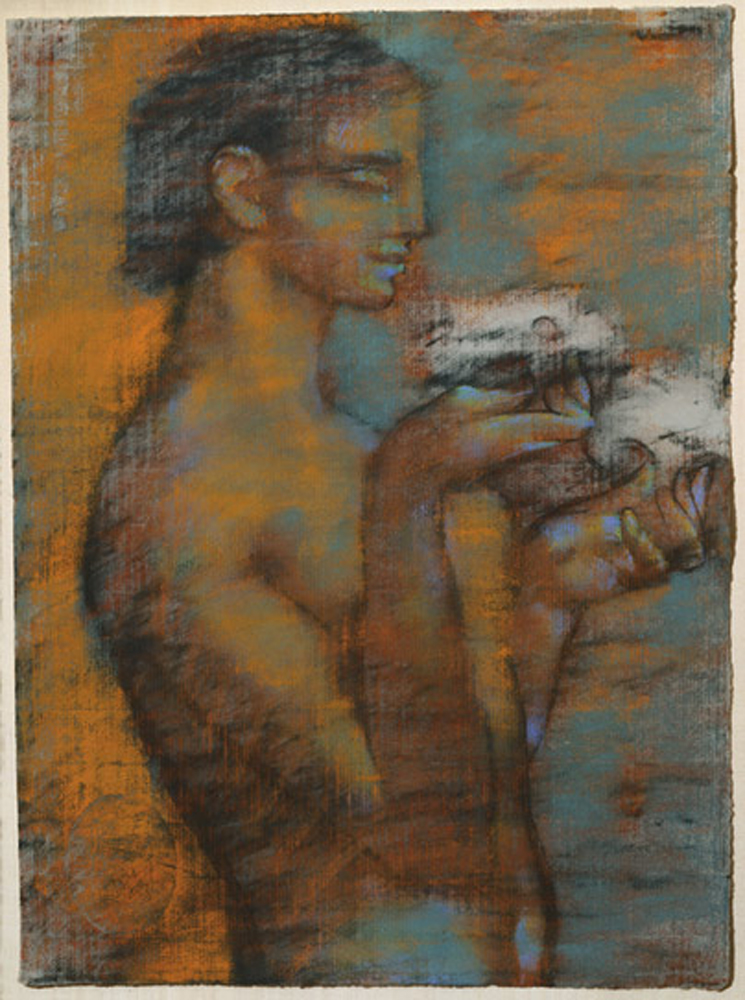
– Voleur de Roses (New Pastels 2001): Offering
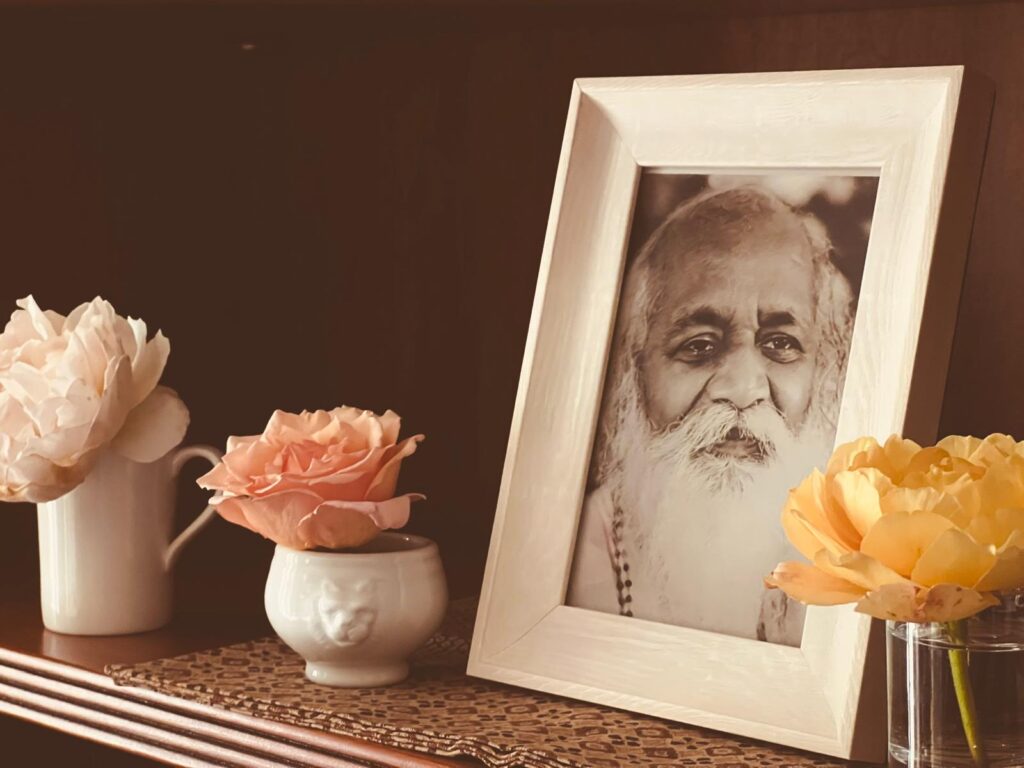
– Altar, July 2026, Germany
Responses